
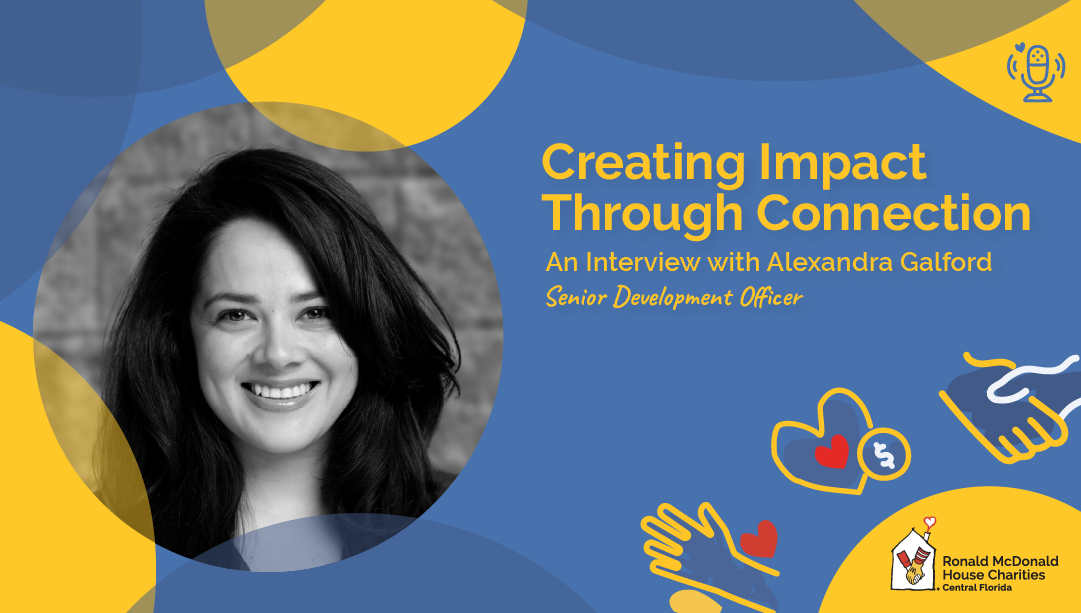
This interview transcript has been lightly edited for clarity.
Jon: Hello, everyone! I am Jon Hill and I’m the Marketing and Creative Specialist at Ronald McDonald House Charities of Central Florida. And today I’m here with Alex Galford.
Alex: Hi! Hi, Jon. Yeah. So, my name is Alexandra, I go by Alex. I am the Senior Development Officer here at Ronald McDonald House Charities of Central Florida. And I am in charge of running our major gift program called the Cornerstone Society.
Jon: Yes. And on top of these, Alex is also a certified nonprofit professional. And I would be remiss if I did not mention that she’s been recognized very recently as an emerging leader in fundraising for the Association of Fundraising Professionals, Central Florida chapter.
Alex: Thank you, thank you. Yes. It’s incredibly humbling to be recognized for doing great things in our community, along with everyone else that is going to be recognized on National Philanthropy Day. So thank you so much, Jon!
Jon: We love having you here, Alex! So what led you to our organization?
Alex: Well, I grew up in Central Florida, in Orlando. Which makes me one of a very few people who still are from Orlando living in Orlando. Growing up in this community has just shaped me for who I am. And I can very vividly remember going on several field trips to local theaters and to the Orlando Science Center growing up. And when you’re traveling towards the Loch Haven Park, near downtown, you pass a beautiful old Victorian yellow house. And you can see it from the street. And I always thought to myself, what is that? I just thought it was so beautiful. It’s, it’s very old Florida Victorian. It has a wraparound porch. It’s yellow and bright. During the holidays is really when it looks just so incredible.
I realized as a young adult that that was the Ronald McDonald House. And I took a deep dive into what their services were–into who is it serving in our community? And, as I was starting my nonprofit career, I thought, what a pillar in our community.
The house has been around since 1996, and, I’m a 90s baby, so that to me was like, wow–it’s it’s amazing that it’s still going! That it’s still very much something that, people who grew up in Orlando, they remember the Ronald McDonald House on Princeton, the yellow beautiful Victorian old Florida house.
What this organization does for families in our community, for anyone who needs it–whether in our community or visiting–is amazing. Serving families without barriers, of income or of really anything is super incredible. That when someone’s going through a medical crisis with their child at the hospital, whether you’re a family of five or you’re a single mom or a single parent, you can stay at the Ronald McDonald House and not have to worry about having to travel back and forth. You can stay with your whole family, with your siblings. And, you know, grandma and grandpa can come and it’s great, it’s wonderful.
And it’s lovely that we’re still going around and serving our families and the organization’s celebrating 50 years, which we’re super excited about. Not our Central Florida chapter, but the Ronald McDonald House Charities as a global organization, is celebrating 50 years this year in 2024. Our chapter is going on 28 years, which is a relatively young chapter in Florida if you can believe that.
So I’ve loved being able to go to this organization and have this.
Jon: I loved how you talked about this being a local organization. Having that iconic house in Florida and now iconic houses in Florida, in the Orlando area. But then also being a part of this global organization, which is celebrating 50 years. We’d be remiss if we did not plug that! We’re very happy to be 50 years young, but having so much more to look forward to and so much room for growth.
What is “Development” Anyway?
I want to talk to you about your role in this organization, knowing you’re in the development space. So you’re fundraising–tell us about that. What does that look like for you? What (does) your day-to-day look like in your role here?
Alex: In, I would say nonprofit speak, “development” is very much a nonprofit term. The term I like to use when I’m out in the community is I’m a fundraiser, and raising money for a cause, and for something that is deeply moving to me and serving my community, is something that I’ve made sure my entire career is built around.
So what gets me excited about fundraising is it’s such a very unique task, that we as fundraisers and I’m sure other fundraisers will be listening to this and they can sigh with relief or with joy–however, it is. It’s really rewarding to be able to raise money and use your talents in such a unique way for the nonprofit sector.
A lot of people like to compare fundraising with sales, and while I understand that comparison, it’s a very different cause and it’s a very different personal choice and decision when you’re in a fundraising role versus in a sales role. I couldn’t sell ice to Eskimos. That’s just something I can’t do. I’m not a good sales person in that sense. However, I am great at being able to talk about the organization that I represent and why I am passionate about being a part of other nonprofit boards in my community, outside of my day-to-day job, here at Ronald McDonald House.
And so I really love fundraising because every single day looks so different from the one previous. And so it’s lovely to be able to come in and say, great, what are my tasks? You know, what’s the day to day look like?
Creating a structure for any fundraiser is kind of key to making sure that you’re building in that time to call donors and cultivate them, email with donors, having lunch, or you know, going out and seeing a donor at an event, you know, if you’re in the same space, those tasks are important to solidify the relationship that you’re building with that person and making sure that you’re approaching it under that specific generation.
How we interact with donors who are millennials, so like our Key Initiative our young professionals board, is very different with how we interact with our donors who are part of our Cornerstone Society, which is our major donor program. Those interactions are very different. And although the day to day tasks for those segments are similar, the interaction itself is very different.
So I may see someone from our Key Initiative group at an event that is geared towards millennials or for that younger generation right now that is in their 20s and 30s versus seeing someone who is maybe on our Board of Directors or even a part of our Lou Ann DeVoogd Society at that same event. I wouldn’t most likely cross paths with both of those people at that one event.
I love it because it’s so different–every single day is a new challenge, and raising money for the organization so that we can serve families is really the ultimate mission. The more money that we’re able to raise as an organization, the more families we’re able to serve, and the more impact we can reach for our community.
Jon: Yeah, exactly all that impact is direct, all that fundraising impact is direct to our families and helping them stay closer together in the midst of really trying times.
Donor Cultivation and Stewardship
So, you talked a lot about the donors and, and cultivating them and this idea of donor stewardship.
Alex: Yeah.
Jon: Which I think is maybe a high level nonprofit term.
Alex: Yes (Laughs).
Jon: But very important. Can you talk more about that and expand on what that means?
Alex: Yeah, stewarding a donor is, making sure that your relationship, whether it’s with a donor or without, you know, where we can we can get as as very technical as talking about stewardship through a philanthropy or nonprofit lens. But I can just use this example as: you’re at the playground. You’re at an age where you have a playground in your school, so you’re maybe in elementary school. And you meet a friend at the playground, and they are not in your class, and you meet them at the playground, and you start building sandcastles for one day. So let’s say that’s Monday.
And the next day you go back and that same friend is not playing with you, but playing with someone else. How can we make sure that you still have that friend by Friday? So, yeah, maybe they aren’t building sandcastles with you on Tuesday, but Wednesday you approach them and you say, hey, I’d love to continue building sandcastles with you. And that sandcastle can only be built if we both do it right? You know, maybe we’re building a fort or, you know, making a moat or however, and you start to build that sandcastle on Wednesday and you start to create a huge castle. On Thursday you want to continue the castle, and then by Friday, you’ve built an amazing piece of art. And both of you are very proud of it and it’s great.
That only comes from us as humans wanting to interact with someone else and really building that relationship. That can come from making sure that we’re doing our due diligence with hearing the other person and hearing their ideas and understanding, really, what makes them want to continue to build sandcastles with you. And that is exactly the same aspect as why do donors want to give to a specific nonprofit or a specific mission?
Here in Central Florida we have donors that are very generous and give towards different nonprofits and different missions. So I always am very intrigued with wanting to know someone’s why. Why does a donor give to our organization? Are they a former family? Have we already served them? Have they stayed with us and they feel moved to want to give back to our organization because they’ve used our services. Or is it something that is different than that? Maybe we have a donor that isn’t a former family. But is very moved by our organization making sure that families stay together when (they’re) going through a medical crisis. The reasoning is going to be very different from one person to the next. I always want to understand the why, because the why equips you with being able to understand their longevity with your organization, but also the future–what does the future look like? What are they excited about? Are they excited about seeing another Ronald McDonald House here in Central Florida, or are they excited about a program? Maybe our Hospitality Cart Program? Are they, you know, do they want to give to that specific program or are they really interested in giving towards the operations of our House? It’s the why (that’s) so intriguing.
Jon: Yeah, absolutely–I love that focus on the why and getting behind the person and getting into what they care about and seeing where our needs and their desires can intersect, and building that personal relationship. I think if there’s anything I’ve taken, I think I need to spend some more time in your office Alex, cause building some sandcastles could be a lot of, could be a lot of fun.
Alex: Listen, I haven’t built a sandcastle in a long time. However, if I have a little bucket that helps me build a sandcastle, I think I’ll be good.
We use different tools here at the organization to help us understand our donor’s whys and making sure we understand that key piece. Because if we understand the why, we will understand that future of the longevity of the donor.
But then also really making sure that we are aligned because there are some donors–and it’s an unpopular opinion with fundraisers–but there are donors that are not for you. You know, maybe their mission is ending homelessness, or assuring everyone has food, you know, breakfast, lunch, and dinner. And while we serve both of those in a very unique capacity, our primary focus is making sure that we have a safe space for our families who are going through medical situations.
So it can be very different if we don’t understand the donor’s why. So making sure that the retention of a donor year over year, and building that relationship in that trust with making sure that we are transparent with our financials, is key in being able to have longevity with any donor.
Jon: Yeah, absolutely, that’s a great point. And being in this big organization, like having those tools to not only steward that relationship, but to extend it and then to have that longevity.
Making the Uncomfortable A Little Easier: Legacy Planning and the Lou Ann DeVoogd Society
Speaking of longevity, I think I’d be, you know, I think I’ve said remiss three times now on this episode. But we’d really be remiss if we didn’t point out that it was National Make-A-Will-Month in August. So it feels prudent to ask, when the time comes, what does legacy planning look like at RMHCCF with us here?
Alex: Yeah, we have an amazing Lou Ann DeVoogd Society for our planned giving, that is our planned giving program. Lou Ann DeVoogd was our founding President & CEO, who retired after 25 years with the organization. So really, we wanted to make sure that we honored her legacy. She was really a driving force with making sure that Orlando had its first Ronald McDonald House, which is that yellow, beautiful Victorian old Florida house off of Princeton.
Legacy planning looks different for everyone. And this goes back to understanding a little bit about where a donor is in their journey of life. So not everyone has a will, right? I’m in the process currently of getting my will together as well. And I’m in my mid 30s so…
Jon: I feel like you’re ahead of the game on that.
Alex: Well yes, I try to be (laughs).
But making sure that when a donor is thinking about those processes that are uncomfortable, I feel like, you know, for anyone no one really wants to think about the after, you know, we’re not physically present here on Earth, you know, what that looks like. But making sure that you can leave a legacy for your community and especially for your family, that really feels meaningful to a lot of our donors who are active in our Lou Ann DeVoogd Society for planned giving. They want to make sure that they’re leaving behind something for the next generation. And it’s really impactful when you have donors who think that way. They want to leave a legacy that they themselves will never see come to fruition, but how beautiful it is that they want to make sure that their legacy is continued on even after they’re no longer here with us.
So it’s really interesting how each person approaches planned giving differently. And we have donors who will tell us that they have written us into their will, and that we are part of their financial planning for their planned giving. And then we have donors that we don’t know, and they have passed on, and we will then, you know, receive notice, from a lawyer that they have left us something in their will, whether that is monetary, or that’s, you know, we’ve been gifted all sorts of things as many nonprofits have. You know, gifted as houses or cars or boats or gifted just the actual cash value monetarily.
So going back to understanding the donor’s why, and having that relationship with them, making sure that when you get to a point when in that donor’s lifetime they’re talking about planned giving that you’re able to approach that subject in a way that honors their legacy. Not everyone is going to want to talk about it and understanding who is going to want to talk about it and what that feels like is really dependent on the relationship that you’ve built with them.
So we are super excited to have unveiled the Lou Ann DeVoogd Society last year in November with Lou Ann (in) a special celebration at our Nemours House. She was taken aback by the emotions of us naming the society after her. So it was really lovely to see. But we have our planned giving plaques up in all of our houses. You know, if anyone wants to be a part of our planned giving in our Lou Ann DeVoogd Society, we want to make sure that we’re honoring them while they’re still with us, so that they’re able to see it and leaving something so important as anything could be, you know, it doesn’t matter the monetary value, but just making sure that they feel like they’re honored in this current life that they’re living with us. And then obviously honoring them after they’ve passed.
Jon: Yeah, no, of course, I think the Lou Ann DeVoogd society is a fantastic addition to our groups of communities here at Ronald McDonald House Charities of Central Florida, with our donors and volunteers. And, you know of course, Alex, you are maybe a bit ahead of the game on will planning and it’s never too early…
Alex: Never too early.
Opportunities for the Next Generation
Jon: But thinking about legacy while we’re here on Earth and thinking about (the) future and just flipping the coin a little bit, what about for the younger generation, you know, students who are growing up and they’re looking to get involved, looking to get experience, maybe volunteer hours and just learn and serve, and kind of scratch that itch to to make a difference.
Alex: Yeah.
Jon: What does that opportunity look like for them?
Alex: Yeah, the opportunities at the Ronald McDonald House are endless. You can volunteer in any capacity. We have an actual in-house volunteer program where we have volunteers come and assist us with daily activities that we have in the Houses.
Junior Cornerstone Society
We have a Junior Cornerstone Society, which is our young people’s society. And we have Junior Cornerstone members from age eight all the way up to age eighteen. And we really are honoring that next generation who want to scratch that itch and make sure that they’re giving back to their community. And a lot of those come from schools, right? So we have a Pop Tabs program. We’re about to launch a new program in schools as well, which I won’t give too many details away, but that’s coming soon.
Jon: Stay tuned.
Alex: Stay tuned.
So we have different opportunities for students who are, you know, not in college yet are still either in high school, middle school, or even elementary school to give back. We’ve had even schools do little fundraisers for us. And when I mean little, it’s their class, right. So it’s thirty students or twenty students that are putting together a fundraiser. I remember one from last year (that was) very sweet. This class did a fabulous card fundraiser. And so they would make cards for the Ronald McDonald House, and each card was 50 cents. And they ended up raising, like over $300, which was amazing to me. And I find that so, so impactful because it’s not about the monetary value of the money that they’re raising. It’s about them getting involved in our organization at such a young age. And through the Junior Cornerstone Society, they’re able to do that all throughout their schooling up until they get to college. And once they’re in college, you know, they can join other missions and things that are important to them and stay active with us and volunteer, you know, come back and do a Share-A-Meal.
Key Initiative
And then (after) they can join our Key Initiative, our young professionals board committee. And so that can still continue to lead them down that path of giving back to their community that they’re growing up in. Our Key Initiative is really, really a unique group in our community. It is, I believe, the only young professional group that has the opportunity to–once they are chair of our Key Initiative group, you know, leading the group with that particular fundraising year–they’re able to assume a position in our Board of Directors. So they’re invited to be a part of our Board of Directors. And that is something that’s very unique, because that level of, kind of direct, connection is unheard of in our community, and that feels really lovely to be able to continue to serve once your time has run its course in Key Initiative, and you’re getting to be more towards the middle of your career and you’re still wanting to be involved and engaged.
You can now sit on our Board of Directors and continue to make a difference and continue to really understand, you know, being on our Board of Directors is an honor in the sense of, we want our community members to feel empowered, to help us make decisions that are best suited for our families. And you know, help us with the financials, help us with the budget-making, help us with strategic planning. And what our vision is for the next year or even two years, three years. That really is heavily reliant on the Board of Directors and it’s wonderful to see that direct connection from Key Initiative to our Board of Directors.
Jon: Yeah, truly, one of the things I love about Ronald McDonald House Charities of Central Florida in particular is all these avenues for service through different seasons of life, all the way (from) Junior Cornerstone to potentially Key Initiative after college and maybe even Cornerstone Society–the last of our trifecta of societies that we haven’t talked about yet.
Alex: (Laughs) Yes.
Jon: I know that’s a bit of your baby, Alex. So, would love to hear more about the Cornerstone Society and how that fits in with all these other ways to get involved. Tell us more about that!
Cornerstone Society
Alex: Yeah! Our Cornerstone Society’s our major gift program. We underwent a great rebrand. Our marketing department did a fabulous job last year with rebranding our logos and just giving it a fresh look–keeping it updated with the times and creating momentum around it as well.
Our major gift program, our donors who give $10,000 or more within a calendar year. We’re a calendar organization and that’s nonprofit speak for we run our financials from January 1st to December 31st. Other nonprofits run their organizations July 1st to June 30th. So that’s just the difference there.
We put on events and cultivation activities for that group specifically for the Cornerstone Society. So it may be a happy hour. It may be taking them on a boat tour. It may be, going all together, going to, you know, see the Orlando Ballet. Something unique where it’s getting the same group of people, who are like-minded people, in the room and creating that community. That community only comes from making sure that people feel engaged around a mission. And what better way to do that then by doing an event? Or, you know, creating an activity, whether that’s even doing a Share-A-Meal at one of our houses making sure we’re all cooking together.
Those opportunities are really those community builders, because if you’re a like-minded person, the idea is that then you can find friendship as well and maybe even do business with someone that you’ve met through the Cornerstone Society. And that feels like we’re not only creating a community and getting to know those donors personally within the organization, but then they get to know each other and then when they see that someone went to an event and maybe they weren’t able to go it’s creating that “Wow, you know, I want to go to that next event that the Cornerstone Society hosts.”
Making sure that our reception in the Fall and our breakfast in the Spring are really events that our Society members want to come to that we are updating them with the mission and the vision that we have as an organization and their impact, right? We want to know how their donations are affecting our organization, and what better way than to have the families tell them the impact of our organization on their journey, you know? And that feels so good.
And the day to day for running the Cornerstone Society, as I mentioned before, looks different every single day, day over day. But it really is making sure that we have a strategic plan in place and creating those moments that we will get engagement and that people want to go to and feel excited about and that, you know, all trails into the larger aspect of year end giving and Giving Tuesday and creating fundraising campaigns around a specific, you know, date or house birthday, all of those really are those key moments where you’re able to donate at a certain level, and then you get a phone call from me, and you’re invited into the Cornerstone Society program. And I tell you all about that, and, yeah, it’s great! I really enjoy what I do, and I really enjoy building those relationships with our donors, and getting them engaged with our organization and in a deeper way.
Jon: If you couldn’t tell, Alex’s passion for connecting with donors and relationship building definitely came out in Cornerstone. Allowing us to just increase our amount of touch points with donors who may not be right next to us here in central Orlando, but (are) further out and hosting events and socials to make sure that they feel valued and that we can connect with them and hear from them and hear about their whys and their needs. And so, yeah, that’s been a great addition to our organization’s lineup, you could say, of Societies that we have.
Providing Warmth in the Midst of Chaos
So getting back to the mission, kind of tying a bow on it. You talked about your passions for development, but specifically the mission of our House of Ronald McDonald House–what does that mission mean to you?
Alex: Yeah, the mission is so unique in the sense that we serve everyone. And it doesn’t matter if you’re a millionaire or if you are living out of your car. We’ve had both at our house. One is not better than the other when you’re going through a crisis.
You know, your child is in the hospital, and no matter what the situation is, you’re in survival mode as a parent. That, to me, goes above and beyond what any organization could possibly do is making sure that the family is close to their sick child. And it might be that that family is visiting us from another country or another state. Maybe they were at Disney or at one of our theme parks here in Central Florida, and an accident happened, and now they are at the hospital with none of their clothes. You know, they have a hotel. That’s really just one instance. It could also be, you know, the child is undergoing treatment of whatever sorts, and they may need to be at the hospital for an amount of time. And we have had families who are driving, you know, an hour and a half, two hours from their home, and they get to come here in Central Florida because care in Central Florida here in Orlando for pediatrics is more advanced than maybe in their community or where they’re from. So we get a lot of those families that live on the outskirts of Central Florida.
We provide service for our nine counties. We provide service for Brevard, Osceola, Orange, which is the county that we have. All three of our houses are in Orange County, Seminole, Volusia, Lake, Sumner, Flagler, and Marion. Those are our nine counties that we serve. So it’s interesting, I think a lot of people assume that we are serving the most amount of families right here in Orlando, and that’s actually the opposite because if you’re living in Orlando, most likely, you might be close to one of these hospitals. So you might not have to need our services as much as a family who might live in Brevard, who–that’s an hour and a half away. Or might, you know, live in Flagler, that’s also an hour and a half away. So the nine counties that we serve, that, to me, feels like a warm hug.
So you’re able to walk into our house and be provided with a private room, a private bathroom, a warm meal at the end of your evening and be able to provide a little bit of that rest for the chaos that is their day-to-day. Our families are living through chaos. Because they don’t really know, right? Their children are being treated at the hospital, and oftentimes they don’t really know what tomorrow is going to bring. And it might be good news and it might be bad news. We’ve had a lot of our families, unfortunately not have good news after their stay with us. And that, you know, it’s devastating for our families themselves. But then also our staff gets really, really involved in our families, and it’s hard on everybody.
So how can we serve our families better? That to me, the mission is so critical, we’re able to serve families who are going through a moment in their life that is chaotic, and we’re able to provide a tiny bit of that warmth, that closeness, that care that we really pride ourselves on here in Orlando–is making sure that we can be warm with our families. We provide them the proximity to their sick child. But then we care. We truly care about what happens, with their family and their situation. And that all goes back to that.
Jon: Yeah we truly do care here at our Ronald McDonald House Charities in Central Florida, and that’s from development staff to operations–everyone who’s in the Houses. We truly do care. And that’s been something I’ve loved to experience since joining here.
One Way You Can Help
Speaking of giving warm hugs and talking about the community that we’re in and those around us, can you speak to ways that if someone around the community wants to, like, get involved, and we’ve already talked about this. Maybe focus on one area and someone could give (something) like a warm hug?
Alex: Yeah, my warm hug. I think something that is really easy for people to do on their own time is creating those snack packs and the hygiene kits that our houses basically run off of. And what that means is we have a snack pack program and a hygiene kit program. So everyone that checks in to our Houses, they may or may not have things with the. If they’re in a true emergency, they are literally coming to us with the clothes that they have on, and that’s it. They don’t have a toothbrush, they don’t have shampoo, they don’t have laundry detergent. They may be staying with us for several days and not knowing until maybe, you know, after a diagnosis or whatever that looks like.
So we asked the community to create hygiene kits and that, you know, both of those kits you can find on our website and you’re able to create that on your own time, you know, whether maybe it’s a Sunday afternoon or a Friday, maybe with your kids or with your community. We’ve had church groups create them. We’ve had corporate supporters create them. Really? Anyone can create a kit for families.
And so the hygiene kits are for our families when they check in. And then the snack packs, those really are the kind of the pivotal point of our houses. The snack packs are packs that they, the families can take with them on their way out the door in the morning to go visit their child at the hospital. So, it’s kind of a grab and go. You grab a snack pack, you maybe a family has a few family members or a few siblings, and they’re all going to the hospital. So everyone grab a snack pack.
We probably go through, you know, several thousand snack packs a year. And the snack packs can be created, you know, in a group setting. But someone–one individual person–can also create a snack pack. I could go to Sam’s or to Costco and buy a few items that are on the list for the snack pack creation and grab some Ziploc bags and start to make, you know, some of them. I mean, it doesn’t doesn’t matter how many you make because they will get used!
So that really feels like something that can be done on your own time. For anyone to participate in and be able to provide an actual service for our organization is those snack packs and hygiene kits are used every single day in our houses, and it’s critical that our community knows that we need them all the time. And that is something you’re able to create on your own time or within a group setting. And we invite you guys to, you know, if you want to participate and give back to your community and, you know, on your own time and, something that is really going to move the needle, I would I would suggest the snack pack and hygiene kit creations, as programs that we have here at the Ronald McDonald House for our families to use day in and day out every single day that they’re with us.
Jon: Yeah, even small things like that can make a huge difference to a family who is away from home. There’s so many little things that we take for granted in our day to day lives that we at the Ronald McDonald House are able to think about and then provide for these families who may have, as you said, just the clothes on their back in an emergency situation. Even those little things can be a strong and comforting touch of home. Even that is very much appreciated.
Yeah. Thank you Alex, this has been a great discussion!
Alex: Thanks, Jon. This is great.
Jon: Absolutely! Loved learning more about, just the wide ranging role that you play, but also your passion for relationship building, really , and creating that community with donors to understand where they’re coming from so that we can better help them and also help our families at the end of the day–because that’s what it’s all about.
Alex: Thank you! Jon, this is great. And I’m excited to see who’s next on the interview list (Laughs). But excited to see more engagement and more volunteers coming through our doors to help our families who are going through a really tough moment in their lives, and we get to see just a very small snapshot of it and hopefully ease a little bit of the pain that they’re in.